

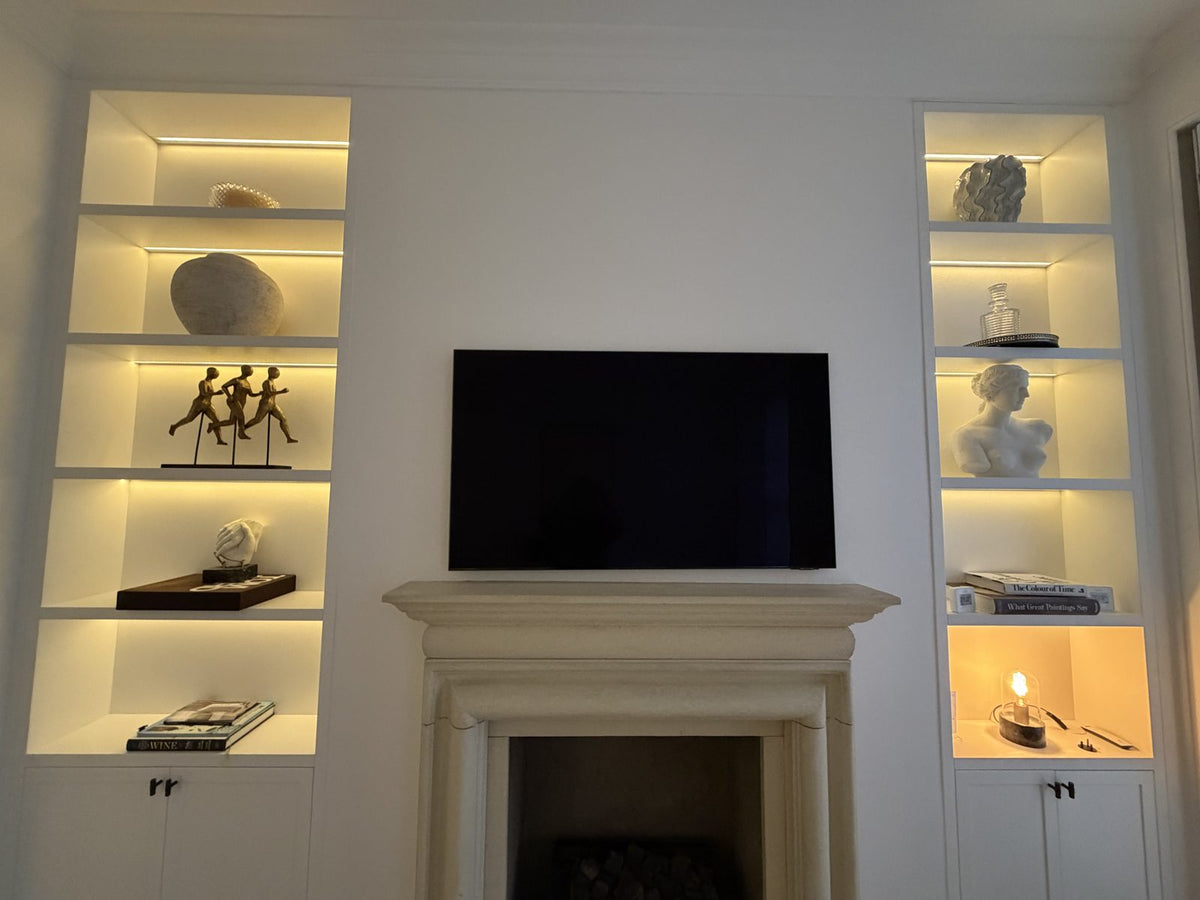
Cheap LED strip usually looks fine from across the room and wrong when you stand in front of it. The light is a slightly different colour from one LED to the next, you can see the dots through the diffuser, and over a long run the far end can look dimmer and warmer than the start. None of that shows on a product listing, which is why two strips that look identical online can look very different in a finished room.
The photos in this guide are from a real installation of a budget LED strip in alcove shelving. Nothing is wrong with the fitting. Everything you see is down to the strip itself.

From a few metres away the shelves look evenly lit. The problems only show up close.
Problem 1: the LEDs are not all the same colour

One LED in this run is visibly more yellow than its neighbours.

Here whole groups of LEDs are warmer, so the shelf has patches of different white.
This is a binning problem. Every white LED that comes off a production line is very slightly different in colour. Manufacturers measure each one and sort them into groups, called bins, by how close they are to the target colour. A tight bin means every LED on the strip looks the same. A loose bin, or LEDs mixed from several bins, means you get exactly what is in these photos: a warm LED next to a cooler one, or a run of yellower LEDs in the middle of a reel.
The industry measures how tight a bin is in MacAdam ellipses, also written as SDCM steps. The smaller the number, the harder it is for the eye to see any difference. At around 3 steps most people cannot tell two LEDs apart. At 5 steps or more, side-by-side differences start to show, and they are most obvious on a pale wall or a white shelf, where there is nothing else for the eye to look at. Budget strip rarely states a binning figure at all.
Problem 2: you can see the dots

Even through a diffuser, each LED shows as a bright spot.
Traditional LED strip, called SMD strip, has individual LEDs spaced along the tape. The fewer LEDs per metre, the further apart they are and the more each one shows as a separate spot of light. A profile with a frosted cover softens this, but only so far: if the LEDs are widely spaced or the profile is shallow, you still see a row of dots, and on a gloss worktop or a glass shelf they reflect too.
The fix is either more LEDs per metre, a deeper profile, or COB strip. COB, short for chip on board, packs hundreds of tiny LEDs per metre under a continuous phosphor coating, so the light comes out as one smooth line with no dots, often with no profile needed at all. Read COB vs SMD LED strip for the full comparison.
Problem 3: the light is uneven along the run

Brightness and colour wander from one LED to the next.
Some unevenness comes from binning. Some comes from the strip itself. Cheap strip often uses thin copper tracks and low-voltage designs, typically 12V, so the voltage drops along the run. The LEDs at the far end get less power than the ones at the start, so a long run fades and can drift warmer towards the end. A 24V strip with good copper carries power further before it fades, which is why most professional kitchen and furniture lighting is 24V. See 12V or 24V LED strip lights?
Problem 4: colours look flat (CRI)
Colour rendering, measured as CRI on a scale up to 100, is how accurately a light shows the true colour of what it lights. A low CRI makes wood look dull, food look grey and skin tones look washed out, even if the light is bright. A higher CRI makes the same shelf of books, the same oak worktop or the same marble splashback look the way it does in daylight. Budget strip often either does not state a CRI or quotes one without saying how it was measured. Every Sensio light is CRI 90 or above. Our CRI guide explains the numbers.

On display shelving every shelf is seen at once, so any colour difference between shelves is obvious.
What else cheap strip saves money on
Adhesive. Thin, generic tape lets go in warm cupboards and behind TVs, so the strip sags out of its profile. Sensio strip uses 3M VHB (very high bond) tape, or push-fit designs with no adhesive at all.
Connections. Clip connectors on budget strip are a common failure point. Sensio COB strips such as Polar X, Polar Pro and Razor X come with pre-soldered driver connection cables, so the joint that matters most is made in the factory.
The driver. A cheap strip is often sold with a cheap driver. Flicker, buzzing and early failure usually come from the driver, not the LEDs. See what size LED driver do I need?
The guarantee. Budget strip often carries 12 months or nothing. If a section fails inside a fitted kitchen, the cost of getting to it is usually more than the strip.
How Sensio LED strip is different
Every Sensio strip is designed for fitted kitchens, bedrooms and furniture, where it will be seen up close every day.
- COB strips with no visible dots. Polar X, Razor X and Polar Pro have 512 LEDs per metre under a continuous coating, for one smooth line of light that can be cut anywhere (Polar X, Razor X) or every 31mm (Polar Pro).
- 24V for long runs. Our main kitchen and furniture strips are 24V, and Polar X runs up to 25m from one end with no fade. 12V versions are for caravans, motorhomes and boats.
- Tight colour tolerance. Our LEDs are selected to a small binning tolerance, so every LED on a reel, and every reel in a kitchen, is the same white. Our spec tables publish the colour range for each white, for example Viva 3 warm white at 2850K to 3150K.
- CRI 90+ on everything. Every Sensio light has a colour rendering index of 90 or above, so wood, stone, food and fabrics look true to life.
- 3M VHB tape or push-fit, and pre-soldered connection cables on the COB ranges.
- 7 year guarantee on every Sensio LED strip, and our TrueFIT service will cut, solder and kit it to your exact lengths.
What to check before you buy any LED strip
- Is the binning tolerance stated? Look for 3 SDCM or 3-step MacAdam or better.
- Is the CRI stated, and is it 90 or above for kitchens and display shelving?
- How many LEDs per metre, or is it COB?
- Is it 24V, and how long a run will it power from one end without fading?
- What adhesive does it use?
- Is it sold with a matched driver, and how long is the guarantee?
If a listing cannot answer those questions, the strip is probably the reason it is cheap.
Frequently asked questions
Why does my LED strip have yellow patches?
Usually because the LEDs on the strip come from different colour bins, so some are warmer than others. It can also happen at the end of a long low-voltage run where the voltage has dropped. Neither can be fixed after installation; the strip needs replacing.
What is LED binning?
Binning is sorting LEDs by colour after manufacture. LEDs from a tight bin all look the same colour. Loose binning causes visible differences from one LED to the next.
What CRI should LED strip have?
CRI 80 is a minimum for most homes. CRI 90 or above is better for kitchens, display shelving and anywhere you look at colour closely. Every Sensio light is CRI 90+.
How do I stop seeing dots on my LED strip?
Use a COB strip, which has no visible dots, or fit an SMD strip in a deeper profile with an opal diffuser. See what is an LED profile?
Is expensive LED strip worth it?
For lighting you will see every day, inside fitted furniture where it is costly to replace, yes. The difference is in colour consistency, how smooth the light is, how long it lasts and what happens if it fails.
Browse our LED strip lights, or read the LED strip buying guide.