
No, there is no difference: LED tape and LED strip are the same product, and the two names are used interchangeably.
Whether a product is sold as LED tape lights, LED strip lights or LED light strips, you are buying the same thing: a thin, flexible circuit board with LEDs along it and an adhesive backing. This guide explains what it is, what actually varies between one strip and another, and how to choose from Sensio's range of LED strip lights.
Why two names for one product?
"Tape" describes the form. The strip is thin, bends around curves and peels off a reel like a roll of tape. "Strip" describes the result, a continuous line of light. Fitters tend to say LED tape, homeowners tend to search for LED strip lights, and manufacturers use both. So if a fitter asks for LED tape and you have LED strip in the van, you have the right product.
What LED tape actually is
LED tape is a flexible printed circuit with LEDs along its length and, usually, a self-adhesive back. The slim Razor X range push-fits into a routed channel or the Edge profile instead.
The strip runs at low voltage, so it needs a driver to step the mains supply down. On a Sensio system the strip plugs into the driver, and the driver either plugs into a standard 3-pin socket using the Driver Lead with Plug, or is wired into the lighting circuit by a qualified electrician so it works from a wall switch. Everything on the 24V side is plug and play, with no soldering.

Polar X COB LED strip on its reel.
What varies between LED strips
The name does not tell you much. These six things do.
Voltage: 24V, 12V or mains
Most Sensio LED strip lights run at 24V. For the same brightness a 24V strip draws half the current of a 12V strip, so it runs cooler and long runs keep their brightness to the far end. Polar X, Polar X Pro and Polar X Duo run up to 25m without fading. Sensio makes 12V versions of Polar X, Polar X Pro and Primo for leisure vehicles. Mains voltage strip also exists; it connects directly to the supply, so it is strictly a job for an electrician. Read 12V or 24V LED strip lights? for the full comparison.
Width and thickness
Width decides where the strip fits and which profile it takes. Neutron is 3.5mm wide, Ion 5 is 5mm, Polar X, Viva 3, Sigma 2 and Primo X are 8mm, Polar X Pro and the Razor X family are 10mm, and Polar RGBCCT is 12mm. Thickness matters for routed channels: Razor X 2mm is 2mm thick and Razor X 4mm is 3.8mm thick, so each suits a different groove.
COB or SMD
SMD strip has individual LEDs spaced along it, so you see points of light when the strip is bare. COB strip packs the chips so closely that the light blends into one continuous line with no visible dots. Polar X has 512 LEDs per metre, against 120 per metre on Primo X. COB looks better where the strip is on show or reflects in a gloss worktop. SMD works well inside a profile with a diffuser and is the economical choice. See COB vs SMD LED strip.
Colour: single colour, dual white, TrioTone, CCT or RGBCCT
Single colour strip gives one fixed white: warm (3000K), natural (4000K) or cool white. Dual white strip such as Polar X Duo gives natural or warm white in one strip, chosen on site with the Duo Flexible Strip Adaptor. TrioTone strip runs from the same single colour receiver. CCT strip adjusts from warm to cool, for example Polar X Pro runs from 2700K to 6500K. RGBCCT strip adds full colour on top of adjustable white, as on Polar RGBCCT and Flux. Each type needs a driver with the matching pin type: 2-pin for single colour, 4-pin for CCT and 6-pin for RGBCCT.
IP rating
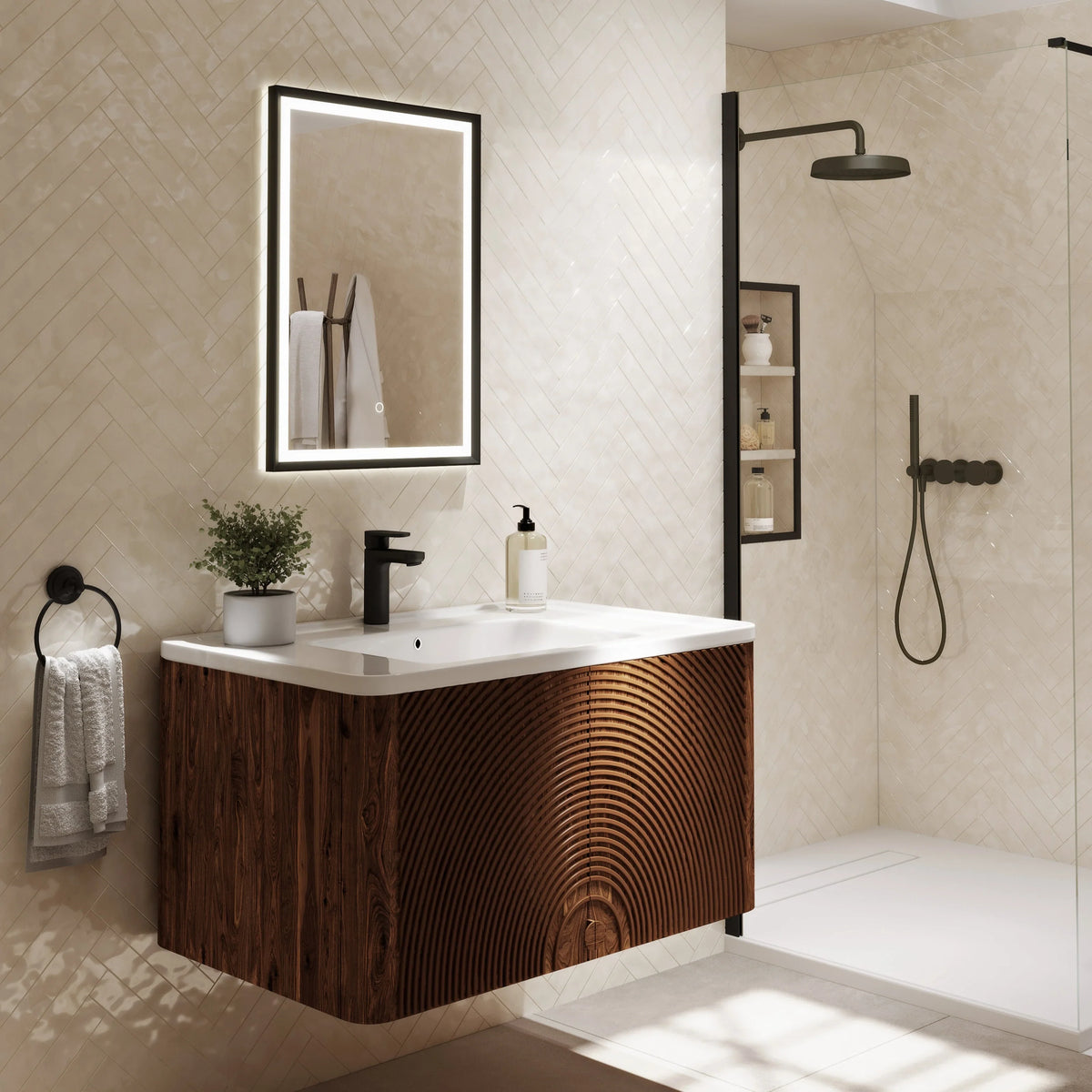
IP20 strip is for dry areas only. Viva 3 is IP54, which protects against sprays, so it suits plinths. Polar X IP65 is sealed against water and approved for bathroom Zone 1 and Zone 2. Radiant X and Radiant Pro are also IP65. Our bathroom zones and IP ratings page shows which rating each zone needs.
Cut points
Every strip can be cut, but not every strip can be cut anywhere. Sensio's free-cut X range (Polar X, Razor X, Primo X, Radiant X and the Duo strips) cuts at any point. Other strips cut at marked intervals: Neutron every 25mm, Polar Pro every 31mm, Ion 5 and Sigma 2 every 50mm, Primo 2 every 100mm and Flux every 142.5mm. Can you cut LED strip lights? lists every strip.

Polar IP65 LED strip.
How to choose
Ask four questions. Will you see the strip or its reflection? If yes, choose COB. Where is it going? Dry areas take IP20, plinths IP54, bathrooms IP65. Do you want to change the colour later? If so, choose CCT or RGBCCT with the matching driver. How long is each run? Measure it, and pick a free-cut strip if the run must end exactly at a cabinet edge.
Then size the driver. Multiply the strip's watts per metre by the length and choose a driver rated above the total. Polar X draws 6 W/m, so 4m needs more than 24W and a 30W driver covers it. Our guide what size LED driver do I need? has a calculator, and the 24V drivers collection lists each pin type.
Where Sensio's ranges fit
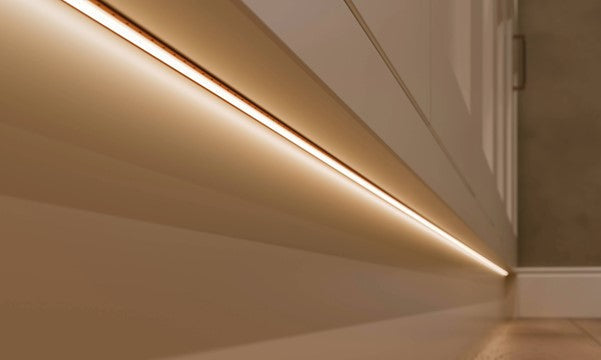
Polar X is the all-rounder: a free-cut COB strip at 600 lm/m for under cabinets and plinths. Polar X Pro adds adjustable white, Polar X Duo lets you pick warm or natural on site, and Polar X IP65 is the bathroom strip. Razor X 2mm and 4mm push-fit into routed channels for handleless kitchens. Neutron and Ion 5 are the narrowest, for shelves and display cabinets. Viva 3 is the plinth strip, Sigma 2 bends around corners, and Primo 2 and Primo X are the economical SMD choices for wardrobes. Polar RGBCCT and Flux cover media walls and feature lighting.
Fit any of them in an aluminium LED profile for a neat, diffused line, and follow how to cut, connect, fit and wire LED strip lights when you install. For larger projects, the TrueFIT service cuts and solders strip to your exact lengths. Every Sensio strip comes with a 7 year guarantee. For a job-by-job comparison, read the LED strip lights buying guide.

Primo X LED strip in natural white.
FAQs
Is LED tape the same as LED strip lights?
Yes. LED tape, LED tape lights, LED strip lights and LED light strips all describe the same product. Choose by voltage, width, COB or SMD, colour type, IP rating and cut points, not by the name.
Do LED tape lights need a driver?
Yes. Sensio strips run at 24V, so each needs a 24V driver with the matching pin type, rated above the total wattage of the strip. The strip plugs into the driver with no soldering. Wiring the driver into the mains is a job for a qualified electrician.
Can you cut LED tape?
Yes. Free-cut strips in the Sensio X range cut anywhere. Other strips cut only at the marked points.
Which LED tape is best for a kitchen?
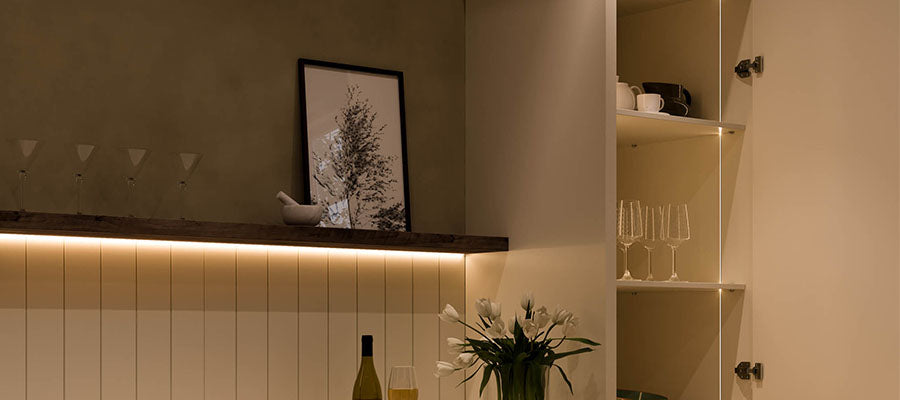
Under wall cabinets, a free-cut COB strip such as Polar X gives a continuous line with no dots reflecting in the worktop. Razor X suits handleless kitchens, and Viva 3 or Sigma 2 suit plinths. See the best LED strip lights for a kitchen.
Can LED strip lights go in a bathroom?
Yes, with the right IP rating for the zone. Polar X IP65 is approved for Zone 1 and Zone 2. IP20 strips are for dry areas only, and all bathroom electrical work must be done by a qualified electrician.