
An LED driver is the correct name for the power supply that LED lights need, and "LED transformer" is the everyday name for the same thing, but a traditional halogen transformer is not a suitable replacement. Sensio lights and strip run at 24V, so they need a 24V Sensio driver, connected to the mains by a qualified electrician.
LED driver vs transformer: the short answer
The two names are used side by side, which is why our range of LED drivers is titled LED Drivers & Transformers. When someone asks for an "LED transformer" they nearly always mean an LED driver: the unit that turns mains power into the low voltage supply LED lights run on.
The difference matters when "transformer" means an older unit made for halogen lamps. That is not a like for like swap for an LED driver.
| LED driver | Halogen transformer | |
|---|---|---|
| Designed for | LED lights and LED strip | Halogen lamps |
| Output | A regulated DC supply, such as 24V | Usually a low voltage AC supply, often 12V |
| Low loads | Designed for the low wattage of LEDs | Many need a minimum load that LEDs may not reach |
| For Sensio lights | Yes, a 24V Sensio driver with the matching pin type | No |
What a transformer does
A transformer changes one AC voltage into another. In lighting, the classic example steps mains voltage down to the low voltage used by halogen spotlights. The output is still alternating current, which suits halogen lamps because they are simply a filament that heats up and glows. Later halogen transformers were often electronic, but the job was the same.
What an LED driver does
LEDs work differently. They run on direct current, and they need that supply kept steady and within limits to give even, flicker free light and a long life. An LED driver takes mains power, converts it to DC and regulates it for the LEDs connected to it.
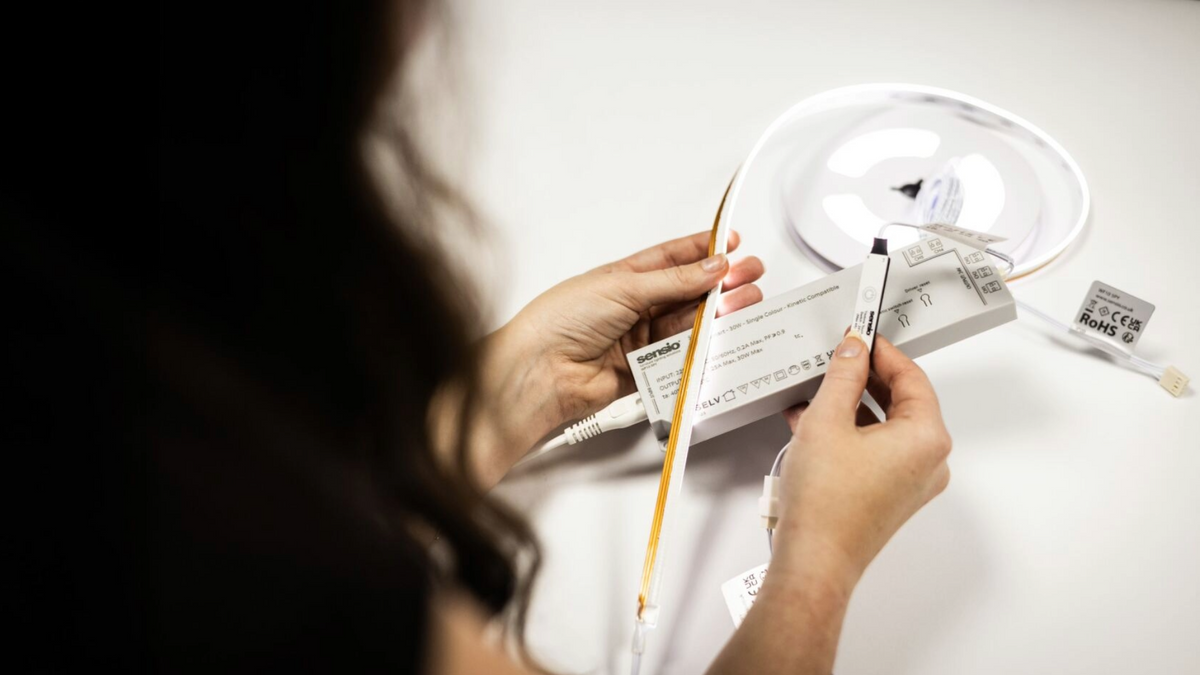
Sensio drivers give a 24V output and have built-in distribution ports, so several lights can plug into one driver. Depending on the model, it also handles control, from sensors to a wall dimmer or app. For a full introduction, read what is an LED driver and how to choose one.
Constant voltage and constant current
LED drivers generally come in two types.
- Constant voltage drivers hold the output at a set voltage, such as 12V or 24V, and the lights draw the current they need. This is the type generally used for LED strip and for lights labelled with a voltage.
- Constant current drivers hold the current at a set level, measured in milliamps (mA), and the voltage varies with the load. They are generally used for lights labelled with a current rather than a voltage, and the driver has to match that current.
Match the driver to what the light is labelled with. Sensio lights and LED strip run at 24V and are designed for a 24V Sensio driver with the matching pin type. For another brand, check the label or ask the manufacturer first, as the wrong type can damage the lights. The voltage must match too: our guide to 12V or 24V LED strip lights explains the difference and why Sensio uses 24V.
Why a halogen transformer is not the right choice
It is tempting to reuse the transformer from old halogen spotlights. In most cases it will not work well, for three reasons.
- The wrong output. Halogen transformers usually give a low voltage AC output, often 12V. LED strip and low voltage LED lights generally need a regulated DC supply, and Sensio lights need 24V.
- Minimum load. Many electronic halogen transformers need a minimum load to work properly. LEDs use far less power than halogen lamps, so the load may fall below that minimum, which can cause flicker or lights that do not come on.
- Not designed for LED. Unless both manufacturers say they are compatible, you cannot rely on it. The safe route is a driver made for the lights.
When you upgrade from halogen to Sensio LED lighting, replace the transformer with a Sensio driver and have a qualified electrician make the mains connection.
Choosing a 24V LED driver for Sensio lights
Every Sensio driver gives 24V, so choose by pin type, control and location. Pin types are 2-pin for single colour and TrioTone® lights, 4-pin for CCT lights that adjust from warm to cool white, and 6-pin for RGBCCT colour changing strip.

| Use | Driver | Sizes and pins |
|---|---|---|
| Sensors and remotes | Titan+™ 24V LED Driver | 6W, 15W, 30W, 60W, 150W, 2-pin. Works with plug-in PIR, IR, switch and door sensors. Not for use with a wall dimmer. |
| Mains wall dimmer | Titan™ Dimmable 24V LED Driver | 15W, 30W, 60W, 2-pin. Dims from 5% to 100% with a mains wall dimmer switch. |
| Smart control | Titan™ Smart Kinetic 24V LED Driver | 15W, 30W, 60W, 2-pin. Link Sensio app, Amazon Alexa, Google Assistant and the wireless Titan Kinetic Switch. |
| Smart CCT | Titan™ Smart Kinetic CCT 24V LED Driver | 15W, 30W, 60W, 4-pin. The same smart control for CCT lights and strip. |
| RGBCCT colour changing | Titan™ Smart RGBCCT 24V LED Driver | 30W, 6-pin. For Polar RGBCCT and Flux strip, with app and voice control. |
| Bathrooms | Titan IP44 Bathroom LED Driver | 30W, IP44 rated for bathroom zone 2, not zone 0 or zone 1. Supplied with an IP44 connection ready to plug and play. |
| Plug-in retrofit | Modus™ Plug-in 24V LED Driver | 30W, UK 3-pin plug. Single colour and TrioTone® lighting and Affinity magnetic track. |
See the full range of 24V LED drivers.
Sizing the driver
Add up the wattage of every light and every metre of LED strip that will run from the driver, then choose a driver rated higher than that total. If you are close to the limit, go up a size. For wattage tables, worked examples and a quick calculator, read what size LED driver do I need, or use the driver calculator, which also suggests the controls and accessories you need.
Watch: choosing and installing a Titan driver
Step by step: how to install a 24V LED driver.
More videos: watch the Drivers, sensors and smart control video playlist on YouTube, or see all our video guides.
FAQs
Do LED lights need a transformer?
LED strip and low voltage LED lights need an LED driver, which many people call an LED transformer. Some LED lights, such as many mains downlights and lamps, have the driver built in. Sensio 24V lights and strip need a 24V Sensio driver.
Is an LED driver the same as a transformer?
"LED transformer" is the everyday name for an LED driver, so in most conversations they mean the same thing. A traditional halogen transformer is different: it was designed for halogen lamps and is not a suitable replacement for an LED driver.
Can I use a halogen transformer with LED lights?
It is not recommended. Halogen transformers usually give a low voltage AC output and many need a minimum load that LEDs may not reach, which can cause flicker or failure. Use a driver designed for the lights, such as a 24V Sensio driver for Sensio lights.
What is a 24V LED transformer?
It is a 24V LED driver: a unit that converts mains power to the 24V that 24V LED lights and strip run on. Sensio drivers run from 6W to 150W, in 2-pin, 4-pin and 6-pin versions.
Do I need a dimmable LED driver?
Only if you want to dim from a mains wall dimmer, in which case use the Titan Dimmable. The Titan+ dims when paired with a sensor, and the smart drivers dim through the app, voice or the Kinetic Switch, but none of these should be used with a wall dimmer.
Where should the LED driver go?
Titan drivers are a slim 16mm deep, so they fit behind kickboards and above wall units. In a bathroom, use the Titan IP44 Driver in zone 2, as set out in our bathroom zones guide. The Modus Plug-in plugs straight into a socket. Any mains connection should be made by a qualified electrician.
Not sure which driver you need? Contact our technical team.